

Maximize The College Experience
A Degree Coach is an experienced specialist with a proven track record of student success in the higher education environment. Coaches provide personalized guidance to each student with academic decisions, resource identification, enrichment opportunities, and graduation planning. Simultaneously, Coaches infuse into the program the development of personal skills that will lead to a higher level executive functioning serving the student well in college and beyond.
Increased Return On Investment
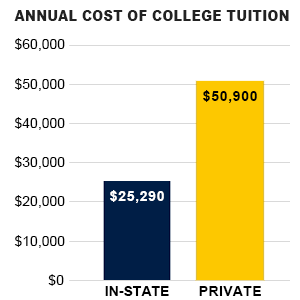
The College Board reports that a for the 2017–2018 academic year a moderate college budget for an in-state public college averaged $25,290; at a private college, the average is $50,900. Included in these budget estimates are all expenses college students incur in a given term including tuition, fees, housing, meals, books, school supplies, transportation, and personal/spending money. (1)
College is a major investment for both students and their parents. Our program adds just a fraction to the overall cost of college, but significantly increases the return on investment by providing a student with an advantage, a Coach.
Personalized Guidance
On every college campus, there are professionals dedicated to student success (academic advisors, tutors, learning specialists, peer mentors, etc.). While all are well-intended and contribute to positive outcomes for students the reality is that the time of these individuals is very limited. With several hundred students in an average caseload, student support personnel do not have the resources to work one-on-one with individual students. U.S. Colleges and Universities maintain an average ratio of 296 students to 1 academic advisor.(2) The norm is for students to have one to three in-person meetings per year with their academic advisor plus a sprinkling of additional contacts (email, phone, listserv, social media, etc.).(3) This level of interaction is not optimal and often proves to be insufficient support for students.
By contrast, frequent coaching sessions allow for trust and rapport to be developed between the student and the coach. Regular collaboration enhances the Coach’s ability to customize the program to the academic and developmental needs of each student keeping in mind the goals of retention in college, completion of the degree, and enhancement of life skills.
Ensure Students Utilize Resources and Capitalize on Enrichment Opportunities
While some resources on a college campus are limited by capacity, other services, and enrichment opportunities are often underutilized by students due to lack of knowledge, poor organization, or an aversion to asking for help.
A 2017 Strata-Gallop survey of 32,000 college students at 43 randomly selected four-year institutions found that fewer than 20% of undergraduates used the services provided by their college Career Services Office.(4) Career Services staff provide expert advice to students on how to market their educational experience in terms of acquired skills, knowledge and competencies and how to create a personal brand especially in the digital age. Career Services Offices also facilitate connections to employers for internship and job opportunities, teach networking skills, and provide basic services such as resume reviews, cover letter critiques, and mock interview drills.
Every student should utilize all of the university support resources that they have paid for via tuition and fees every semester. Coaches assist students to identify the support resources available on their campus and guide students on when and how to best use these services enabling them to become self-advocates.
Maximizing the college experience also means taking advantage of enrichment opportunities such as study abroad, internships, research, service-learning, leadership in student organizations, etc. Coaches work with students to figure out what opportunities will serve them best based on their academic and career goals. Coaches also strategize when and where in their academic plans these activities best fit to supplement (not supplant) the work done directly in the classroom.
What Our Students Say About Us

Fred T.
College GraduateMelissa is an excellent Coach with deep knowledge of how to succeed and thrive in the college environment. She empathetically encouraged me to set my goals, challenge myself, and ask for help when I didn’t always know how to. Melissa served as a guide as I tried to do more with my time than I sometimes should. I recommend working with her if you have the opportunity.
Ben S.
College SeniorThank you for all of your support!
Jenny M.
College SeniorI'm very thankful to work with you over these past four years, the guidance/mentoring is truly a blessing. Once again, thank you for everything! Especially for the reminder to rest and not stress over the break.
Pratyusha M.
College SeniorI’m grateful for all the help you’ve provided me over the past three years. Your patience and helpfulness have made these past semesters a lot less scary and stressful.
Arjun M.
College GraduateI Graduated! I can’t begin to thank you enough. You were here for me when I thought the world was falling apart, when it actually did fall apart, and through it all still had faith in me. Thank you from the bottom of my heart!
Ziyaad K.
College GraduateThank you so much for helping me every step of the way to graduation, I always felt great after talking to you. You are <strong>EXCELLENT</strong> at what you do, and I really appreciate you!
Caleb W.
College SeniorThank you so much for solving my advising/registration issues. You are so kind and empathetic the best!
Jihyun B.
College SeniorI am truly grateful for the concern and patience you demonstrate toward each of your students.
Mina S.
College SeniorThank you so much for helping me get that scholarship! You’ve been awesome and very helpful to me.
FOOTNOTES
The College Board – https://www.collegeboard.org/
Robbins, R. (2013). Implications of advising load. In Carlstrom, A., 2011 national survey of academic advising. (Monograph No. 25). Manhattan, KS: National Academic Advising Association. Retrieved from the NACADA Clearinghouse of Academic Advising Resources website: http://www.nacada.ksu.edu/tabid/3318/articleType/ArticleView/articleId/94/article.aspx.
Kevin Fosnacht, Alexander C. McCormick, Jennifer N. Nailos, and Amy K. Ribera (2017) Frequency of First-Year Student Interactions With Advisors. NACADA Journal: 2017, Vol. 37, No. 1, pp. 74-86. https://doi.org/10.12930/NACADA-15-048
The Atlantic Why Aren’t College Students Using Career Services? Harnessing the resource could help them achieve the graduate’s dream: finding a job. By Lolade Fadolu, Jan. 20 2018 URL: https://www.theatlantic.com/education/archive/2018/01/why-arent-college-students-using-career-services/551051/ – original source Strada-Gallup 2017 College Student Survey